
Mostly aftermarket-mapped Turbos. For the solenoids that control boost see Turbo boost solenoids: where they are, how to test and replace them. For what owners did at stages 1 and 2 see Turbo stage 1 and 2: what owners did. For the recirculation valve and its springs see Turbo recirc valve: compressor stall, turkey noises and springs, and for the VXR turbo itself Swapping the standard turbo for the VXR turbo. For supercharged cars see Supercharged boost pressure: the flat curve and reading MAP logs.
Overboost, then held boost
- A list quoted in a 2006 reply (its author isn't shown in our copy and it is cut off, so treat it as one tuner's claim) gave: standard VXT boosts to 9.5 psi and holds 8.5 to 9; a TMS stage 2 VXT boosts to 15 psi and holds 14 to 14.5; stage 3 boosts to 18 psi and holds 17.
- One owner found his AMD-mapped car peaked at 15 psi and then held about 12, on a track day with intake temperatures of 55 to 60 degrees C. Another owner said his standard VXT boosted to 12 psi but held only 8, and after a stage 1 map still 12 and 10. The tuner told him that is how some turbos are.
- One owner's explanation (2006). It is "completely normal" for peak boost to exceed held boost, because getting a turbo to spin up quickly needs one kind of behaviour and holding the level needs another. He gave five reasons held boost can fall: friction and heat in the turbo, a deliberately conservative held boost in the map (held boost is what kills turbos), the actuator (a spring that sometimes needs replacing), heat (the ECU backs off boost), and the boost controller (he called the VXT one "a bit crap" at holding level boost as the tune goes up). He said they were testing aftermarket boost controllers, nothing confirmed. This is one tuner's view from 2006.
- 2013, a remapped VXT (VXR turbo, Miltek decat): the tuner had it overboosting to about 1.5 bar and the boost line wavered. One owner said 1.5 bar is definitely too high and that stage 4s overboost at 1.3 to 1.5 bar. Another owner said if 1.5 bar is 21 psi that is stage 4 territory (about 300 bhp), normally with a bigger intercooler or charge cooler, VXR injectors and an uprated clutch. A third owner's car overboosts to 1.5 bar and settles to about 1 bar on a VXR turbo with a standard clutch and intercooler, and has done 2,000 miles and four track days without trouble, though it is slightly down on power after about 10 minutes of sustained boost on a hot day. A fourth owner said a standard clutch won't last.
- The wavering. One owner read the dyno print-out: overboost to 22 psi is fine and the held boost is much lower, with useful torque from 3,000 to 4,500 rpm that then tails off, and fuelling that looks consistent, richening to a 0.8 target lambda. He said the yo-yo in the boost line may be a sign the actuator needs adjusting. Another owner said to back the actuator off a turn or two. The owner had it fully backed off already, and a second tuning firm wasn't concerned, so he left it. We don't have the print-out (it was a PDF).
- Charge cooler or intercooler. The owner planned a bigger intercooler or charge cooler. JOHN W said an MMG stage 4 intercooler gave no change in intake temperatures even with more spirited runs. One owner had used both a TAT and an MMG intercooler before changing to a charge cooler and said there wasn't much in it. See Turbo charge cooler kit fitting and Turbo cooling circuit and upgrades.
Low boost cases
A hole in the induction pipe (2008)
One owner's 2003 AMD stage 2 VXT felt flat and sluggish below 4,000 rpm. With a gauge he saw about 9.5 psi overboost and 9 psi sustained, which seemed low for a stage 2, and said vacuum was 22 inHg at idle cold, 26 warm and off the scale on the overrun. Another owner's car read 15, 20 and 21 inHg, and another owner said one owner's sounded like a blockage, since it should be 15 psi or more with an AMD map. Another owner's own cause had been a weak actuator spring that made the gauge and the dyno print wobble on overboost. One owner found the real cause after removing the metal heat shield at the back of the block: it had burnt or rubbed a hole in the induction piping. With a temporary duct tape repair, overboost was 15 psi and sustained 12 psi, dropping off slowly at high rpm. He called it like a different car, and said a proper replacement pipe was still to come.
Vacuum hoses and the recirc valve
- In 2006 one owner said a similar problem was first blamed on the wastegate actuator (he wrote "New Turbo" and said an aftermarket actuator kit is available) but turned out to be a leaking vacuum hose, which he tightened.
- One owner lost a considerable amount of boost and 100 hp when a vacuum pipe fell off the recirculating valve next to the vacuum store.
- See also the solenoid guide for pipes popping off and for hose clip tips.
A 2016 case that wasn't solved (K04, stage 3)
One owner's K04 car with a charge cooler, 3 inch exhaust and open filter made good boost (about 1.3 bar) from low revs, then fell to about 0.5 bar at around 3,500 rpm. He had pressure tested the intake system, checked the thin vacuum hoses, fitted a Forge recirc valve (after the problem started, with the yellow spring), changed both solenoids, tried the original intercooler against the charge cooler, checked the cat and exhaust flow, swapped the hose between the air mass meter and turbo for a metal tube, and taken the turbo off and the compressor cover off to inspect it. With the wastegate hose disconnected, and with the wastegate forced shut with a metal thread, there was no difference. With the solenoid unplugged there was no difference. There were no fault codes, the penny valve closed well, the actuator held pressure, and it didn't move under throttle. He also noted that it lost more when really hot than on a cold first pull (73 degrees), and that the problem started after he fixed a long-standing charge cooler leak.
- One owner said 0.5 bar is most often the wastegate's minimum pressure, and suspected the wastegate and that the solenoid and ECU were pushing everything to reach the target. He asked about the recirc valve and its spring. Another owner said to unplug the solenoid: if it holds boost above actuator spring pressure, look at the turbo or wastegate set-up and a sticking penny valve or actuator. A third owner asked about a collapsing intake hose.
- One owner asked whether the valve was an open (atmospheric) Forge or the recirculating one, said the one in his second photo is fitted wrong, and suggested trying a different spring and checking the O-rings and pistons for damage. Then he said to forget it all if the owner meant the recirc valve on the turbo. Another owner did mean the recirc valve on the turbo.
- Outcome. The thread ends with the compressor housing looking good and no cause found.
Flutter at part throttle (2017, stage 4, not solved)
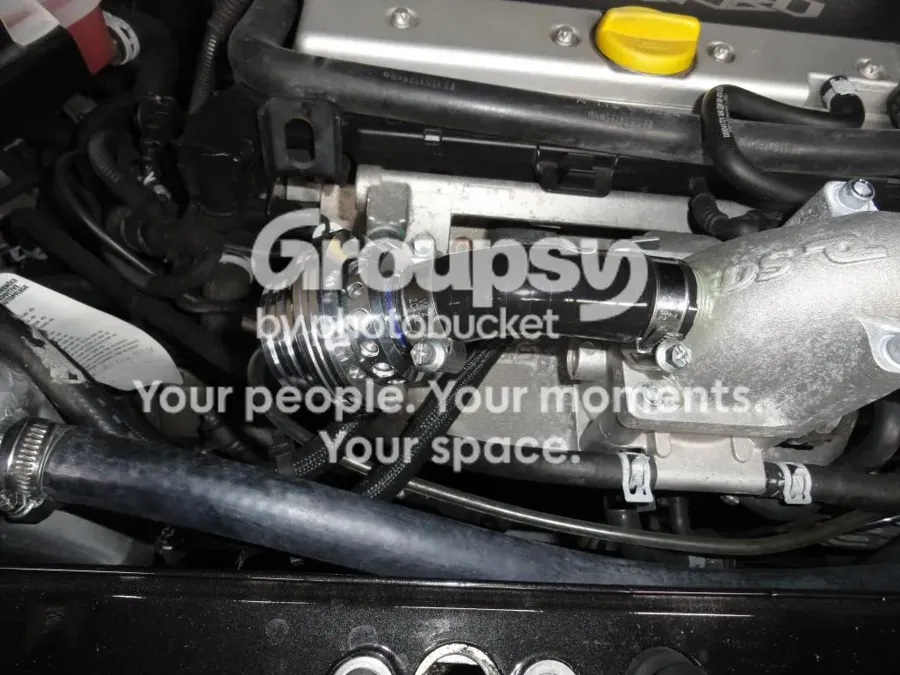
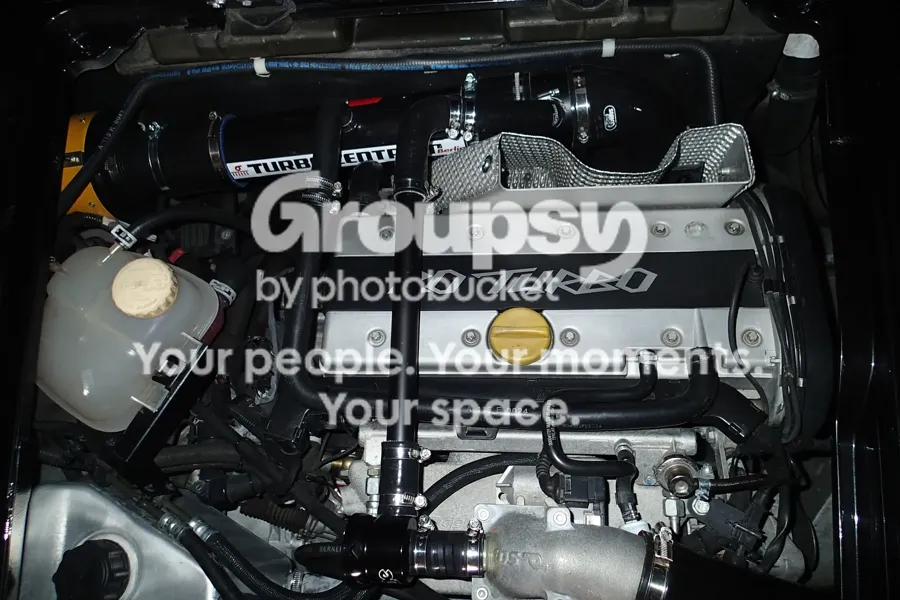
One owner's stage 4 stalled badly at about 13 psi on gradual throttle (not at wide open throttle), with jerking and loss of boost, and fluttering even at 14 psi. He had tried a Forge recirc valve with its red spring and others, replaced vacuum lines, run without the inlet solenoid, run an electronic boost controller and then a manual one set to 1.1 bar, and still had the problem. His boost gauge had logged a peak of 1.7 bar (about 24.5 psi), more than it should.
- Check the exhaust. If the engine can't swallow the boost the turbo pushes out, suspect a restricted cat or silencer even if the car passed its MOT. His test: disconnect the downpipe from the rest of the exhaust and put a metal spacer in the joint so it is open by 1 to 2 cm, then take a short drive. It will be noisy, the engine light may come on, and it doesn't test the pre-cat. Don't do it for long, because the gas can overheat nearby parts such as the sump. It takes an hour or two. He thought a sticky wastegate unlikely, because stuck closed it would show about 20 psi.
- Unplug the air mass meter. A free 10 second job, safe in his view, since the ECU then uses other measures of airflow. One owner did, and said it improved a lot: the jerking and bogging disappeared but some flutter at part throttle remained. Another owner thought it could be two faults, one a dodgy meter or its wiring. A third owner said the meter doesn't cause turbo stall or chatter and pointed at the recirc valve, and possibly the clutch pedal switch or bracket. Lifting the clutch pedal with his foot made no difference.
- The recirc valve on part throttle. One owner pointed out that in 5th gear on gradual throttle the recirc valve should be firmly closed, so it shouldn't dictate stall. Another owner said his own surges, which occurred when reducing throttle, improved after changing both solenoids, fitting a Forge in place of the rubber recirc, changing intake and exhaust pipework and remapping, and were rare after that (green spring at standard, yellow with a stage 2 remap).
- Solenoid test. One owner described a blow test with a 12 V feed. See the solenoid guide.
- Terms. One owner pointed out that a "DV" usually means a dump valve, which vents to atmosphere, while ours is a recirculation valve that returns the boost into the inlet. See also MAF sensor faults.
- The thread ends without a result.
Pipes, sleeves and popped hoses (2014 to 2020)
Four more threads where the boost problem came down to the air path. The two from 2020 ended with a cause (a clip and a hose); several owners never reported back.
Standard map, boost dying away (2014)
- One owner had a VXR turbo on a standard map. It wouldn't overboost, peaked at 8 psi, and fell to about 5 psi after 3,000 rpm. He had found no pipe leaks and the vacuum was fine, and extra actuator preload only got it to 9 psi. He asked whether a 3 year old actuator was duff.
- One owner said 9 psi on a standard map sounds about right. Another owner said it is supposed to overboost at low revs and then drop to a lower steady level (see a third owner above). A fourth owner said to put a bike pump on the actuator and see what pressure it opens at. One owner suggested disconnecting the air mass meter to test it (he had a car that wouldn't rev past about 3,500 rpm after fitting a cheap eBay one). A fifth owner's was a Bosch one a few months old. Yet another owner pointed to something about a collapsing boost pipe, probably a link, which isn't in our copy. The thread doesn't say how a fifth owner got on.
- A split rubber sleeve. His stage 4 wouldn't go past 1.0 bar after the pipework and actuator checked out. One owner told him by private message to check a rubber sleeve in the pipework below the inlet manifold. At first he looked without removing it and thought it was fine. One owner said take it off and look properly, and there was a split at the back of the sleeve. A £1.10 part gave "perfect boost again". His description doesn't make clear which sleeve it is.
Strangled at 3,000 to 4,000 rpm (one owner, 2014, not solved)
One owner's nearly standard car (sports cat on the exhaust) would begin to boost at 3,000 to 4,000 rpm and then feel strangled and flat, though it revved freely with the clutch dipped. It was fine in 1st to 3rd and had an odd torque curve in 4th, with no engine light. A new air mass meter helped briefly after the ECU reset and then it dwindled. His idle sometimes hovered at 300 to 500 rpm.
- The OEM intake pipe. One owner said the rubber pipe from the airbox to the turbo ages and can go soft with exhaust heat and collapse, strangling the turbo's air supply, and said to replace it with a Pro-Alloy part or make your own. Another owner asked how to tell whether it had collapsed when it "uncollapses" off boost. Nobody answered. See also MAF sensor faults.
- Rough idle is a different problem. One owner said it couldn't be put down to the pipe: plugs or a coil pack. Another owner said rough idle means a vacuum leak. A third owner said to check the vacuum storage box under the inlet manifold, where the little boots come off, and that coil packs and plugs tend to misfire under load. Another owner said the carbon canister solenoid could be venting into the intake vacuum, so pull the vacuum hoses off the intake one at a time and plug the hole to isolate the source. A fourth owner said to test the car with the air mass meter disconnected, so the map defaults, and a fifth owner said to read the fault codes. Yet another owner had a boost problem caused by a worn throttle pedal assembly.
- In 2018 another owner asked whether one owner ever fixed it, with the same symptoms. There was no reply in our copy.
A popped intercooler hose (2020)
- The failure. At cruising speed, one owner lost power suddenly and kept slowing to a halt. It would turn over but then die. After a 90 minute wait and £125 for the RAC, the patrol worked out that an intercooler clip had come loose and disconnected the intercooler, and had it running again in about 20 minutes. Another owner said to replace the jubilee clips with decent ones.
- Afterwards. A louder hiss from the turbo side at 3,000 to 3,500 rpm. One owner said the passenger side is naturally louder because the filter is there. His check: rear wheel off (driver's side) and arch liner out, make sure the bottom hose is connected correctly and the top hose to the intercooler is pushed fully on, then put some washing-up liquid (we read his "fairly liquid" as that) around the seals with the engine running and look for bubbles. He said if a hose pops the car won't idle and stalls unless you unplug the air mass meter, which lets it run so you can drive home off boost. His own hose kept blowing off because it wasn't far enough on the alloy pipe.
- The power loss that followed. A few weeks later one owner's stage 4 pulled back at about 3,500 rpm in third, as if hitting a wall, with a louder, fluttering whoosh. Another owner guessed a broken turbo. A third owner said that driving any distance with a big boost leak could have overspeeded the turbo, but to check the basics first (hoses, a damaged recirc diaphragm). A fourth owner disagreed: a car with a popped pipe stalls and won't drive, and a faulty turbo doesn't lose power at one rev range and then get it back. Other suggestions were a dyno session, the actuator, vacuum lines, the recirc valve and control solenoids, and the auxiliary water pump fuse, which a fifth owner said causes this problem (yet another owner said it is in the boot by the yellow relay). The a fifth owner claim is unexplained in the thread.
- Outcome. The service and MOT found "a simple boost hose fix". The thread doesn't say which hose.
A bigger turbo: what might it make? (2012)
One owner had a GT2871 conversion (a stage 5 package from one supplier) on a standalone ECU, and asked what boost others ran for about 370 bhp.
- One owner said from his research you can sensibly expect about 370 bhp from a GT2871 on a Z20LEx, perhaps 380. His dyno comparison picture didn't survive, and he didn't know the boost levels it was made at. The GT2871 plot was from Klassen on the standard ECU.
- His view: 2 bar isn't mega boost for a mid-sized turbo, the GT2871 is capable of a usable pressure ratio of about 2.6 (so about 1.6 bar of steady boost, perhaps more), and a larger inlet airbox and pipework makes more difference the bigger the turbo gets (he guessed even 25 bhp). A smaller exhaust housing could cause back-pressure heat in the manifold and head.
- One owner's car made 345 bhp at about 18 to 19 psi before 5,000 rpm, but the downpipe supplied couldn't vent the boost, so the map wasn't done past 5,000 rpm. Another owner thought a final map might reach about 400 bhp, since 345 at about 1.2 bar left headroom. One owner thought the exhaust manifold becomes a restriction at about 400.
- Charge cooler limit. One owner said a Pro-Alloy charge cooler may limit the boost you can run (his is 2.0 bar), because the aluminium side walls may fail from metal fatigue from constant changes in boost. Check yours.
- Fuel. One owner said 630 cc injectors are OK to about 500 bhp (80% duty), and that the Sytec pump should be OK to about 425 bhp, plus or minus 25, from flow figures he took from a retailer. A 480 cc VXR injector would need over 80% duty even at 5 bar. Another owner said that on his car the standard injectors maxed out at about 250 bhp at the hubs, the VXRs at 265, and 630 Siemens injectors were flat out at 420 bhp at the hubs with race fuel. See Injectors for supercharged cars, which discusses the duty cycle.
- Without an air mass meter. One owner said removing the meter probably increases fuel consumption slightly (he guessed 2 to 4 mpg), because the ECU loses information about air density, but he would still prefer it as one less point of failure.