
What the valve is for
- The idea (2009). When you lift off the throttle the throttle plate closes, which traps pressurised air between it and the turbo's compressor. With nowhere to go it tries to blow backwards through the turbo. A recirculation valve gives it an easier route: it dumps the air back into the inlet before the turbo, after the air mass meter. He said an atmospheric dump valve is "always a bad idea" on a car with an air mass meter, which is his view. One owner (2011) pointed out the same difference of terms: a dump valve vents to the air, ours recirculates.
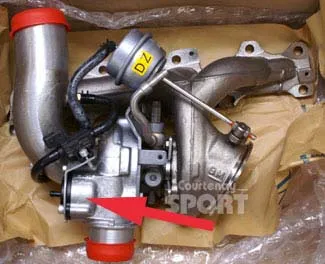
- The standard valve. One owner first assumed the VXR turbo had no valve on it, then corrected himself: the stock turbo has an integral recirculation valve (another owner said it is built into the turbo outlet). The photo another owner posted (below) shows a VXR turbo with the vacuum connection for it. One owner said that connection should go to the inlet tract after the throttle plate, usually on the inlet manifold.
- The signal (2011). The solenoid on the inlet manifold measures the pressure going into the engine (vacuum or boost) and sends a pressure signal down a vacuum pipe, round the alternator side of the engine, to the turbo's integral recirc valve.
The “turkey” noise: what it is and what it costs
- Compressor stall (2011). The "turkey" sound is the turbo stalling, when boosted air flows backwards because the throttle has suddenly closed. He called it a bad thing, since it stresses the turbo's thrust washer and bearing, which are already a weak part, and will make it need replacing sooner (he quoted about £600 for a new one). He said very severe and sudden reversing of the turbo can even shear the compressor blades, though he had never heard of it happening on the standard turbo.
- The 2009 case. One owner had a very audible "tsssch" on gear changes ever since he bought his car, and assumed an aftermarket dump valve. After a turbo replacement (a VXR unit from Courtenays after a cracked manifold) he had more induction roar at 2,000 to 3,000 rpm on partial throttle and compressor stall when lifting off part throttle. He found no aftermarket valve and all the hoses looked fine, apart from one perished vacuum hose from the "rear BCS" (he didn't say which solenoid that is). Replacing it didn't cure it. He asked whether to bypass the solenoid. The thread doesn't say what the fault was.
- A split diaphragm. By analogy with the Bosch valve used on VWs, he suggested a split diaphragm, which leaves you with no working valve at all. He said these are especially likely on cars with raised boost, and last only 40,000 to 80,000 miles. That was from his experience of other cars, not ours. He also said running so much boost that the valve can't cope is possible.
- Check the boost first. His part-throttle roar became a scream with a "tsssst" on throttle-off. He bought a boost gauge and found about 20 psi. He turned the wastegate actuator down to stock levels (12 psi overboost dropping to about 10), and the scream and the tssst went. He said turn both nuts anti-clockwise to reduce boost, and linked a thread that is not in our copy. Treat this as one owner's fix for a car that was overboosting, and don't adjust the actuator without a gauge. The 20 psi is his reading from one gauge.
- Other cases. One owner (2011) said excessive chatter can point to a failed recirc valve. Another owner's checklist included checking the valve's rubber for splits, and he posted a photo captioned "split recirc valve" (not saved in our copy).
A part-throttle on-off case (2011)
One owner's VXT (mapped by Regal and Courtenay in the past, 275 to 280 hp on a TMS dyno, by his account) jumped on boost very quickly at half to three-quarter throttle, then dropped off the power as acceleration caught up, with the wastegate chattering. That upset the car in longer corners on track.
- One owner's checklist: vacuum pipes (connection, perishing, splits), remove the recirc valve and look for splits in the rubber, replace the front and rear solenoids, check the actuator, and the inlet pipe collapsing (unlikely with those symptoms, he thought). Turkey noises tend to be vacuum pipes, the recirc valve or the inlet manifold solenoid, he said.
- One owner ordered both solenoids and a Forge valve and fitted the valve, a 30 minute job. The valve he took out wasn't standard as he had assumed. With the Forge, the turkey noises were more regular. The turbo-side solenoid had been disconnected but not sealed off, so he plugged the open connections, which improved things. Replacing the inlet manifold solenoid made little difference and left a cough with an occasional pop at 2,500 rpm. His car also had an AEM Tru Boost controller with a dash gauge.
- One owner suggested the Forge may have been fitted wrongly (the flat section and hole should point at about 10 o'clock), or the spring was wrong. Another owner thought he had it at 10 o'clock.
- He swapped the spring: out came a blue and in went a yellow. He said that was a huge improvement, with the chattering almost gone ("85 pc cure"). A red was worse than ever, so yellow went back. He was happy on and off boost.
- At Silverstone he was happier at lower boost settings, which made the car easier mid-corner, and he said he might try one owner's setup (below).
His second question, why the turkey is worse when the car is cold, wasn't answered in the thread.
Spring colours
One owner (2011) quoted this as "lifted from Courtenays". We haven't seen the original, and the table is for the Forge valve as sold by that firm. It is a supplier's guide, not a standard.
| Spring | Courtenays' use, per one owner |
|---|---|
| Green | Standard cars with standard boost |
| Yellow | Mapped cars, including VX220 Turbo stages 1 to 4 on the original or VXR turbo |
| Blue | Hybrid VXR turbos running higher boost |
That fits one owner's result (yellow better than blue), though he wasn't sure his turbo was standard, and the owner in the flutter thread used red and others without luck (see the boost diagnosis guide). Red isn't on the list above.
One owner's DV30
- One owner (2011) suggested a Bailey DV30 recirculation valve, which he said releases boost better than the integral valve in the standard turbo. On his own stage 4 it "80% resolved" the stalling, and he very rarely got the turbo to stall after that. He added that every car is a bit different and called it a cheap fix that could save a £600 turbo.
- With it fitted he sealed off the vacuum pipe leading from the inlet manifold solenoid, because the DV30 replaces the standard valve. The solenoid is therefore redundant on his car, to his knowledge, though he left it fitted in case the mappers needed it. Don't copy this without checking how your own car's map and plumbing work.
- He said his own car was "wholly different" from one owner's, and suggested ringing Bruce at Bailey Motorsport for advice.
- Why the part-throttle behaviour at all. He said it is a general characteristic: the turbo is small and keen to spin, so it acts almost like an on/off switch, and a stage 4 map makes it run about 50% more boost than the standard one, taking it out of its ideal range on the compressor map. He thought it "semi-unresolvable" without a bigger turbo, and said you can learn to feather the throttle. One owner said his own 275 to 300 bhp car was similar, and changes at Courtenay after a 3 inch exhaust (an 80 mm air mass meter, a different top hat, a fixed intake temperature sensor and rolling road map changes) only slightly improved it.