
Two 2016 threads from supercharged owners, mostly with OBD Tuner or HPTuners ECUs. The numbers are what individuals logged, not limits. For the supercharger itself see Supercharger installation on the Z22SE, for injectors Injectors for supercharged cars, and for Turbos Turbo boost: low held boost, overboost and flutter.
Why boost goes flat above about 5,000 rpm
One owner (2016) had a Harrop on a 70 mm pulley making about 1.1 bar maximum, and asked why the boost pressure flat-lined from about 5,000 rpm to 7,500 rpm when every supercharger project he had worked on before had a boost curve that followed revs to the limiter. His earlier M62 did the same at a lower pressure. The charger speed rises a lot over that range but boost doesn't. The answers:
- It is normal for a fixed displacement charger. The charger is driven from the crank, so for every crank revolution it moves a fixed volume of air (his simplified example: the charger turns twice per crank revolution and moves 2 x 1.32 litres, against 1.2 litres of engine displacement, so the manifold pressure is raised by a factor of about 2.2 at any rpm). Real boost is more complex because of leak paths and thermal efficiency. He said if boost rises sharply at the top end, then the head, cams or exhaust are beginning to cost you power, and that boost is really a measure of restriction. He called 1.15 bar "very very good" for the pulley size and power.
- Volumetric efficiency. One owner said that on a fixed displacement charger you often see the manifold pressure change when the engine comes "on cam" and its volumetric efficiency reaches its peak: the boost on the dyno drops while the power goes up, because the engine is consuming more of the air. Before and after that point the manifold pressures tend to be higher. Another owner agreed, and said that with head work the peak VE could move up the rev range. He guessed the boost should rise again by about 6,500 but may not because of the Laminovas, and that a bigger charger may be needed if nothing else is wrong. These are theories, not tests.
- A restrictive manifold. He said the flat boost is due to the restrictive manifold, and that this is the argument for one: with the M62 and lower boost (and less rotor leakage) the pressures balance at a much lower point than with the TVS. One owner didn't think the manifold alone could explain it.
- The Laminovas. One owner wanted boost measured before and after the Laminova heat exchangers. Another owner ordered a fitting for the sandwich plate before them to measure the pressure drop, and planned a run without them. Both several owners thought a run without them would be an interesting test.
- Cams. One owner asked whether the intake cam has verniers to allow more overlap. Another owner asked to see low-rpm torque on the dyno to see how the cams behave.
- Belt slip. A multi-rib belt needs to be surprisingly tight to prevent slip on the supercharger pulley, especially a small one. One owner once chased a low boost problem (on a different car) before someone suggested checking belt slip, and thought an optical rpm meter might show it on a dyno. Another owner had dyno-tested on a 5-rib belt and had just bought a 6-rib one. A third owner said the extreme option is to change to toothed pulleys and belt.
- 5-rib or 6-rib belt: not agreed. One owner said a 5-rib gives less slip because the same spring tension puts more pressure on each rib, and a wider belt is only for strength. Another owner replied that with the same tension a 6-rib has 20% more surface to grip, and serpentine belts are made to mesh, and that otherwise we would all drive on very narrow tyres. Nobody tested it.
- The bypass valve. One owner wondered whether the bypass valve was levelling the pressure. Another owner said no, it is a fixed displacement pump, and a third owner said the bypass only works for cruising and start-up. A fourth owner said the bypass should stay open at idle and low throttle and closed at full throttle, and said he had checked this by pointing a small security camera at the actuator. He added that an Eaton type blower's efficiency falls off as it nears its design upper rpm.
- Intake restriction. Another owner asked about an intake restriction. One owner said he was running an LS4 throttle body and, at that point, no intake system, so it could take all the air it wanted.
- A twin-screw alternative. One owner thought it would be interesting if anyone fitted a twin-screw (Lysholm) charger, since they have very little leak-back and keep pushing hard at high rpm. Nobody had.
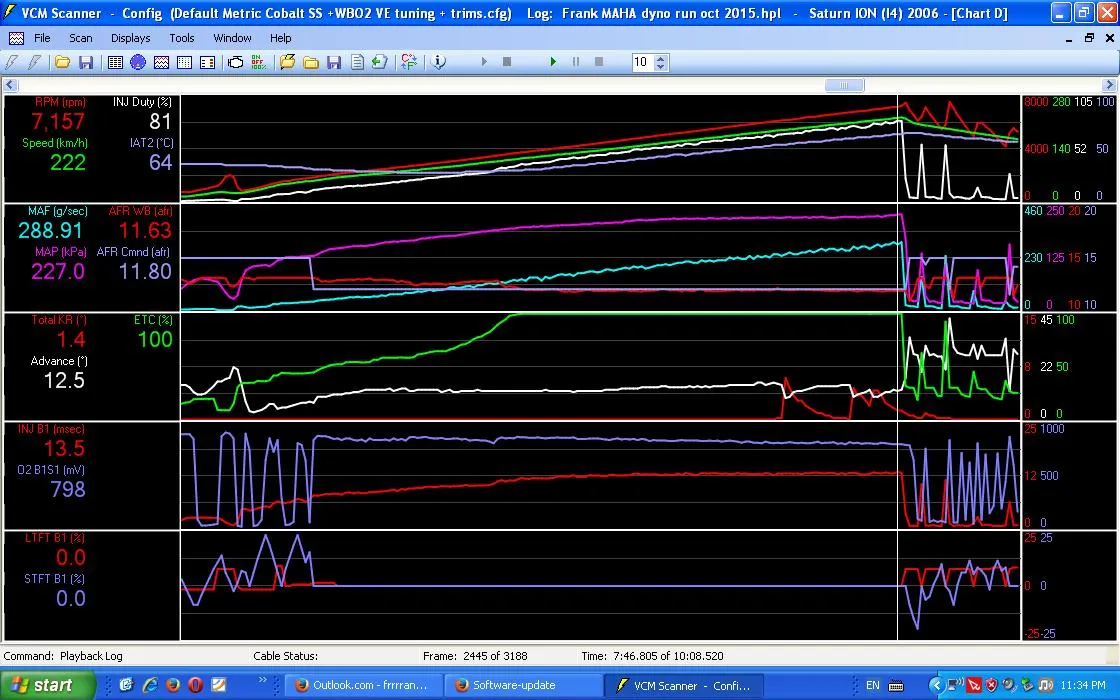
Reading a MAP log
One owner (2016) had just bought a stage 2 car and wanted to check boost before taking it to Courtenays for final mapping. His first calculation was wrong because he mixed absolute and gauge readings. What owners said:
- Absolute versus gauge. One owner said the MAP sensor reads absolute pressure from the ECU's point of view, so 100 kPa is atmospheric, or 1 bar, and idle vacuum is around 30 kPa. A boost gauge treats atmosphere as zero, so you read about minus 0.7 bar at idle. A max reading of 15 kPa would mean either 0.15 bar of boost or 0.85 bar of vacuum, which makes no sense at full throttle. For a gauge reading, subtract the atmospheric pressure from the absolute reading (our arithmetic: 180 kPa absolute is about 80 kPa on a gauge, or about 11.6 psi).
- What to expect. Engine off, the MAP should log about 100 kPa (1 bar, atmospheric), so check this. At idle about 30 to 40 kPa (0.6 to 0.7 bar of vacuum), depending on idle rpm and cams. For a stage 2 supercharged car at full boost, about 180 kPa, which is +0.8 bar or about 12 psi. The maximum depends on the exhaust, the head and the pulley, and a low reading at higher revs could mean belt slip or a boost leak (though you would usually also get a vacuum leak).
- The Courtenay stage 2 doubles it. One owner pointed out that the Courtenay stage 2 uses a "faked" 2 bar MAP sensor in place of the OEM 1 bar one, so the logging software, which translates the sensor voltage using the 1 bar specification, shows half the real pressure. Multiply what you log by 2.
- The case. Stage 2, 3.35 inch pulley, standard cams, standard exhaust with the pre-cat removed, 68 mm throttle body. Logged with OBD Doctor Free on a tablet: engine off 54 kPa, idle 22 kPa (940 rpm), maximum 15 kPa. Doubled that is 108, 44 and 30. The first two fit, but one owner said 44 kPa at idle is too little vacuum (the ideal is about 30) and suspected a leak. Another owner said that at 940 rpm about 40 kPa is normal and at 800 rpm you should see 30 to 35, and that a full-throttle reading with more vacuum than idle must be a wrong value (perhaps logged on deceleration). When he logged again in April the maximum was 81 kPa, which doubled is 162 kPa or about 8.9 psi, matching Courtenays' expected 9 to 10 psi. Another owner's earlier range for full throttle was 80 to 90 kPa logged, or 160 to 180 doubled. The owner asked whether the extra revs of the final map would bring it nearer 180 kPa, which wasn't answered.
- Barometric pressure. One owner asked whether people record outside barometric pressure when comparing logs, and said to subtract the standard value from the MAP reading to compare. He wrote it as 1013 kPa, which we take to be 1013 millibar or 101.3 kPa.
- A simple check. A third owner suggested a temporary gauge for test purposes.
Help wanted
We don't have a boost log from a standard supercharger kit with the matching pulley size, a result from the Laminova pressure drop test or the belt tests, or the ECU or logging settings that give true MAP on a Courtenay car. If you have logged MAP on a supercharged car, please tell us the pulley, cams, exhaust, ECU and what you saw.