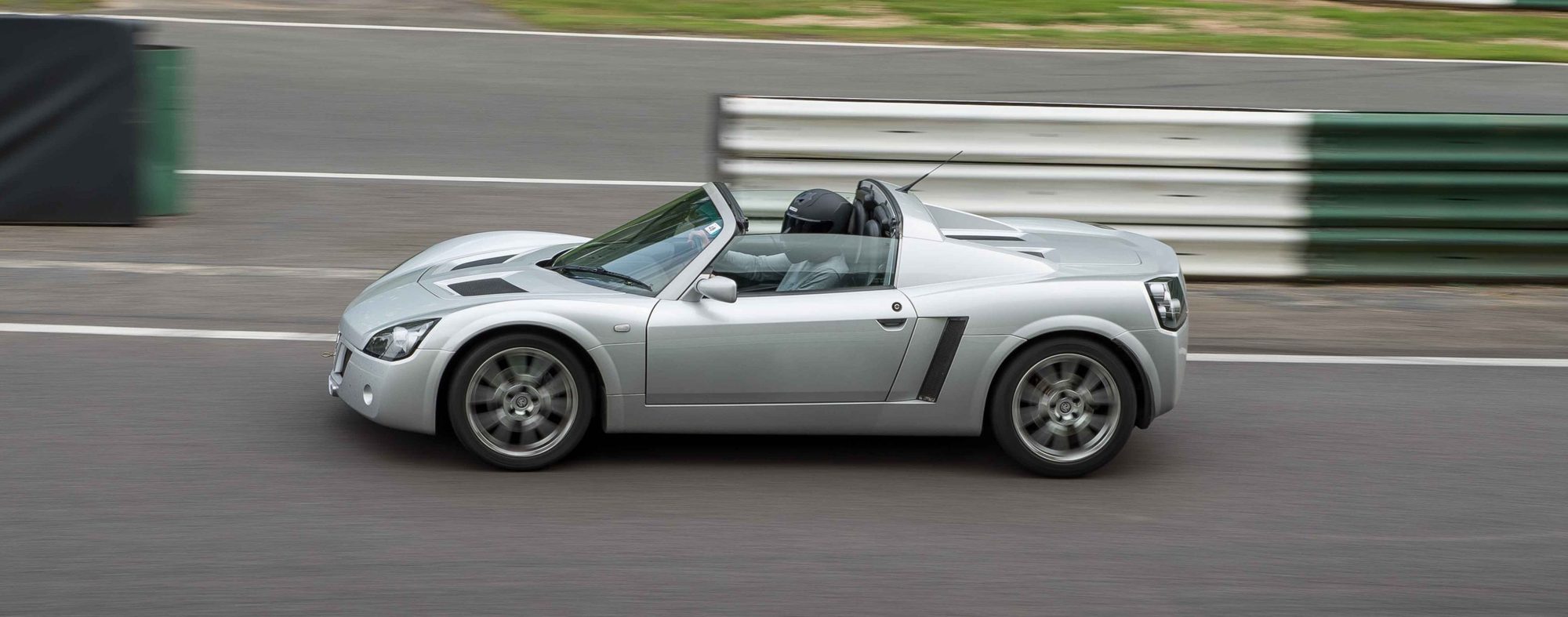
The standard shocks wear out, and when they do the car gets crashy and the rears can leak. This guide is what owners said about the choices, in threads over 20 years. It is opinion, not test data, and prices change, so we give none. For fitting adjustable coilovers see Adjustable shocks: fitting, for the factory steps Shock absorber and spring removal and replacement, and for the other parts to do at the same time Suspension refresh.
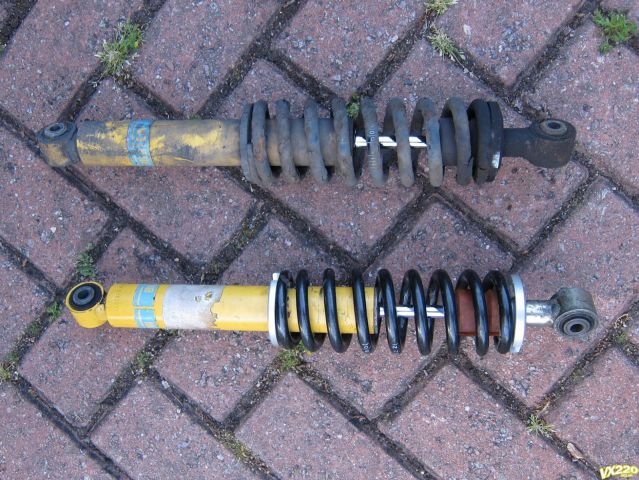
What is standard
- The Turbo has yellow Bilstein shocks, according to two owners in 2011. One said the springs are black and Eibach, and another said Eibach springs were not standard, so we haven't settled the spring make.
- There is no adjustment on the standard springs and dampers (2004). Toe and camber are adjustable at both ends, and caster too with washers. See Camber and castor adjustment.
Are they worn?
- One owner said the old-fashioned bounce test is best, though you can guess from the mileage.
- A 2011 owner replaced the rears when the spring seats were cracking.
- An owner in 2015 said to check the spring collars as well. His were shot at about 50,000 miles and were an extra expense. See also the warning about cracked collars in the fitting guide.
- An owner with two leaky rears on an NA asked about replacing them in 2015. One owner advised that you should always replace all four at the same time, though another said his fronts seemed fine when he needed rears.
- One owner said many dampers feel like an upgrade simply because the old 15-year-old Bilsteins were finished.
The options owners used
Refurbish the standard Bilsteins
- Owners said Bilstein will refurbish them. In 2015 an owner quoted a charge per corner that was cheaper than new, with a further charge if the pistons had suffered side damage, which he was told is more likely on a VX220. He said they would replace damaged spring collars within the price.
- Experience was mixed. One owner gave up on it because of poor communication and not wanting his dampers to go into a black hole, and thought they might not refurb pitted pistons. Others mentioned long lead times, so ask first.
- Owners who wanted to stay standard also looked at new OEM units through a supplier, or a second-hand set to refurbish. One owner said new standard dampers are a small market, which is why they are sold separately from refresh kits.
Exige or Elise Bilsteins
- NA owners in 2011 reported that Exige Bilsteins from a 2005 or 2006 car fitted the front and rear with no modifications, and the car felt less crashy and livelier. One said the set took a little over an hour including jacking and wheels, and that he didn't need to have the geometry done. Two NA owners had them.
- Rear dampers from a Toyota-engined S2 Elise were fitted by two NA owners, who said the rear subframe is the same as the VX220's and the height and rate are much the same as standard. A supplier had told an owner they weren't compatible, and two owners said that was wrong.
- Height. Reports disagree. One owner said fitting them with Eibach springs needs lowering mounts at the front, as they raise the ride height slightly. A Turbo owner in 2015 who fitted new Toyota-engined Elise Bilstein rears (he couldn't find Turbo dampers) said the Exige shocks have their spring seats about 30 mm lower than the Turbo's, so they won't suit if you want to keep standard ride height. In 2019 another owner warned that they may leave a larger front wheel gap.
- Another owner said the Exige Bilsteins are a touch harsher on poor road surfaces. Whether they work on a Turbo was asked in 2011 and not answered, so check the spring seat position with your supplier before buying.
Quantum Zeros (non-adjustable)
- Described by owners as an upgrade that gives an OEM-like ride and is designed as a replacement for the original Bilsteins, with adjustable ride height and a choice of spring rates, including progressive springs. Several owners recommended them for fit-and-forget road use.
- One owner who chose them in 2015 had new springs, a new front anti-roll bar and the geometry done at the same time, and said it transformed the car, safer and grippier. Another owner said a lot of that result comes from setting up what you have properly. A third replied that it doesn't when the old Bilsteins are worn out.
- A 2019 owner said Nitron seem to have better build quality than Quantum per mile, even if Quantum may shade them dynamically. That is one view.
Nitron
- Street Series (NSS). Owners in 2019 were pleased with them for the road and the occasional track day. One said they are comfortable and not crashy, if stiffer than 80,000-mile originals, with adjustable rebound. The front mounting brackets need replacing for the wider damper. Another owner on almost full soft with an uprated anti-roll bar said it felt planted, less crashy and rolled less. Both said to get the geometry done afterwards.
- Ride height. One owner said the NSS drop the car by about 1 to 1.5 inches depending on the set-up, so watch speed bumps and steep garage ramps.
- Reliability. One owner who praised Nitron found his fronts broke after nine years and 40,000 miles unserviced, one with a broken spring and one with an oil leak, and said he would buy Nitron again.
- Higher up the range owners mentioned the Club Sport and NTR dampers. One owner who moved to Nitron multiways from another make called them epic.
- Springs. In 2025 an owner whose Nitron springs were heavily corroded was told they take 2.25 inch springs, so any of the correct length and rate will do. Options were new springs from a spring maker, second-hand ones, or having the old springs blasted and powder coated, or Nitron could supply them.
Gaz
- Gaz Gold Pro were described in 2015 as good value and fine for the road. In 2019 one owner called them ok but budget, and another said they were a lot better than 15-year-old Bilsteins but not all that.
- One owner said the first Gaz Gold Pro were recalled and replaced with a second version after several failures. Another asked whether Gaz had a bad reputation for failing. We haven't confirmed this.
- Gaz monotubes were recommended for road and track by two owners, one saying they transformed the car.
Others mentioned
- Second-hand Sachs dampers and springs were recommended in 2011 as a better ride than standard on bumpy roads. That owner said the springs are progressive and stiffen up. Another owner ran Sachs at standard ride height and said they worked better with an adjustable anti-roll bar.
- AVO were rated by one owner who had them on a previous car, but he found them very hard even on the softest setting. Another said AVO will make a unit to the same spec if you send them yours.
- Fitting dampers is quick. One owner said it takes about ten minutes to change a damper without disturbing the other parts, which is why refresh kits sell them separately.
Spring rates and feel
Owners disagreed, so these are views rather than advice. The rates are in the lb/in the owners quoted.
- One owner who had driven two standard Turbos on the road found them floaty and rolling a lot in bends. Another driver found a standard Turbo set-up soft but fantastic on a circuit. An owner on firm settings said his taste is for solid, while a third said road cars are best on the softer springs.
- One owner said 300 front and 400 rear on Nitrons is firm but fair, with no roll when the dampers are wound up, and wondered why rates went so much higher. He guessed an equivalent might be 400 to 500 for an NA, and a little more for a Turbo, as the Elise is lighter. Another used 350 front and 425 rear as a good compromise, with good roll resistance and without unloading a wheel over bumps and camber. A 2015 recollection of one specialist's advice for the road was 275 front with a 200 to 400 progressive rear.
- An owner explained progressive springs as having bigger gaps at the ends of the coils and closer coils in the middle, soft at first and stiffening as they compress. Another said all springs are progressive by nature, so ask the seller what the rate does.
- One owner said the set-up matters more than the brand, and a good geometry set-up and correct spring rate yield most of the result. Another said a proper configuration of what you already have will yield about 90 percent of the result. These are opinions.
See Wheel alignment for the geometry check you should have after any change.
Related parts
- Rear toe link ball joints. In 2010 an owner found that the outer ball joints are available separately from Lotus, so the bar doesn't need replacing as a whole. Another owner warned that the NA and Turbo ones are different. A later post said the Lotus listing is under a different part number prefix, and a Lotus garage said the parts are the same. There is also a rose-jointed version Lotus introduced as an upgrade, which one owner said has a short life. All of this is second-hand.
- Lower steering universal joint. In 2010 an owner heard it can be bought separately from the complete assembly. We haven't seen this confirmed.
- Part numbers. In 2025 the garage for a 2003 Turbo gave an owner these for the car: off-side front top wishbone 93178252, off-side shock top mount bracket 9197819, and near-side rear drive boots 9197864 and 9197858. We haven't checked them, and the thread doesn't say if they were right. Owners suggested a specialist, or second-hand parts online.
Help wanted
We would like to know which Exige or Elise Bilstein part numbers fit the Turbo front and rear without changing ride height, and how the standard Turbo spring and damper rates compare with them.