
Who can do it
- Many tyre shops only do toe, and bog standard garages tend to do front alignment only. It can be hard to find a tyre place that will measure camber and castor.
- One local garage said it needed the undertray off and couldn't do the cambers because they use shims. Another owner says no undertray removal is needed for camber.
- Taking a VX to a fast-fit tyre place was compared to taking it to a local painter and decorator for a respray. The owners in these threads recommend specialists who know the Elise and VX, with a decent machine such as a Hunter.
- A four-post lift needs the rear undertray off to reach the rear jacking points (a picture from the Elise service manual was posted). See Jacking and supporting the car.
Factory figures
Front, from the TIS
This was posted from the Vauxhall TIS in 2005. It shows both engines, and it gives different figures for the Turbo.
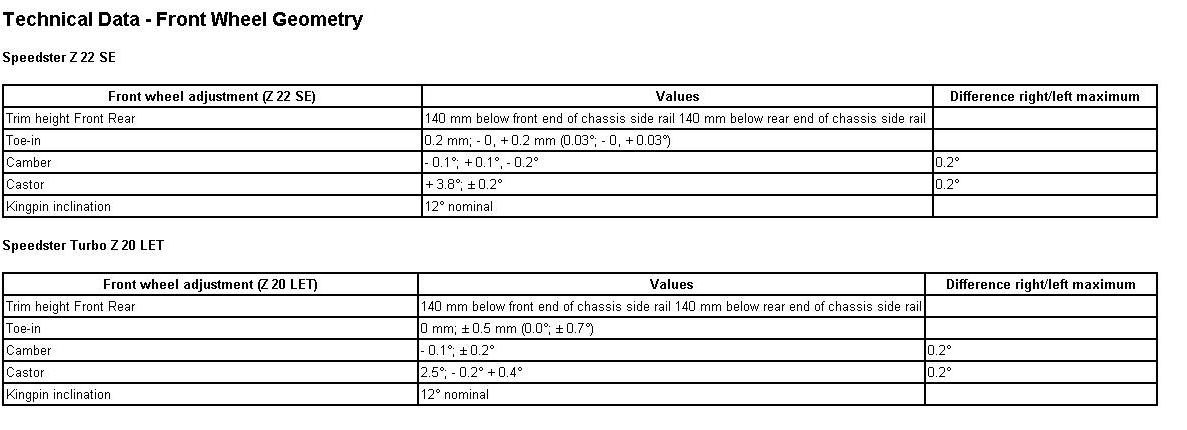
| NA (Z22SE) | Turbo (Z20LET) | |
|---|---|---|
| Trim height, front and rear | 140 mm below the front end of the chassis side rail, and 140 mm below the rear end | |
| Toe-in | 0.2 mm (-0, +0.2 mm), which is 0.03° (-0, +0.03°) | 0 mm, ±0.5 mm (0.0°, ±0.7° as printed) |
| Camber | -0.1° (+0.1°, -0.2°) | -0.1°, ±0.2° |
| Castor | +3.8°, ±0.2° | 2.5° (-0.2°, +0.4°) |
| Kingpin inclination | 12° nominal | 12° nominal |
| Maximum difference right/left | Camber 0.2°, castor 0.2° | |
The Turbo's toe in the screenshot reads "0.7°" for a tolerance of ±0.5 mm, which doesn't look right next to the NA's 0.03°. It is copied as printed.
Rear, from the TIS
This is the TIS page Technical Data, Group F, Rear Wheel Geometry, printed in 2005, which was added to this guide separately from the forum threads. It gives the same figures for the NA and the Turbo.
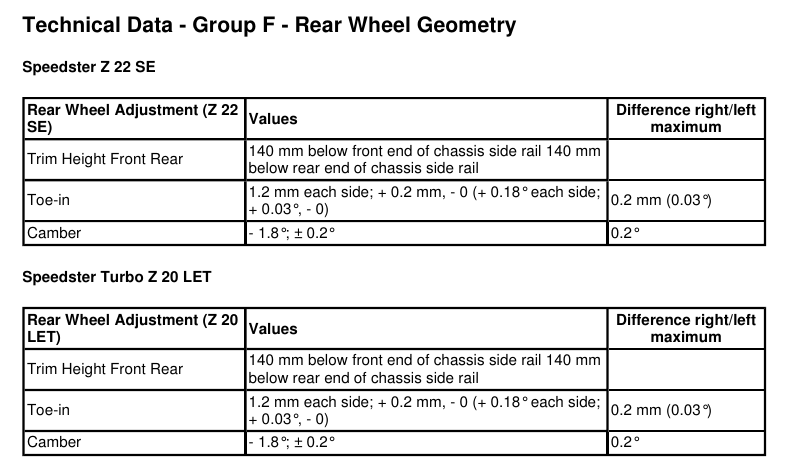
| NA and Turbo | |
|---|---|
| Trim height, front and rear | 140 mm below the front end of the chassis side rail, and 140 mm below the rear end |
| Toe-in, each side | 1.2 mm (+0.2 mm, -0), which is +0.18° each side (+0.03°, -0) |
| Camber | -1.8°, ±0.2° |
| Maximum difference right/left | Toe 0.2 mm (0.03°), camber 0.2° |
This matches what owners quoted in the threads, and the figure in the Rear toe links guide. The rear toe is in millimetres first, with degrees in brackets.
Older figures that are still quoted
In 2003 an older set was posted from the Yahoo board, and found again in 2007. The source isn't known. It was noted as "a bit of a difference" from the TIS set, and caused confusion. Use the TIS set above. For comparison, the older set was: front camber -0.06° (+0.06/-0.12), castor +3.48° (±0.12), toe -0.20 (±0.20); rear camber -1.48° (±0.12), toe +0.12 (+0.20/-0). The units on the toe figures aren't given.
About the toe sign. In the forum text the front toe is quoted as -0.03, with a note that positive means toe-in. The TIS tables, which are headed "Toe-in", show the NA front as 0.2 mm (-0, +0.2 mm), which is 0.03° (-0, +0.03°), and show no minus on the nominal value. Our reading is that the forum's "-0.03" was a mis-copy of the same figure, and that the TIS means a small amount of toe-in. That is our reading, not something the threads say, so check which convention the operator's machine uses.
Conditions for the figures
- The TIS says they apply with 70 kg on each front seat and a half-full fuel tank. The older set says two 70 kg passengers and a three-quarter tank. One owner says the Lotus and Vauxhall figures are based on 75 kg in each seat and half a tank, at the specified ride height.
- Wheel diameter doesn't matter. It is the rolling radius of the wheel and tyre that counts, and that is within a few mm of the Elise.
Does the ballast matter?
The owners don't agree. One says if you simply set it to the factory figures without the ballast, you end up with something rather different from what you expect, particularly with soft standard springs. Another had his car aligned without ballast on standard suspension, and it "handled like crap". Just sitting in the car changed the toe by about 20 minutes toe-out. He now sets cars with the driver in the seat. With 275 lb front springs there was no difference with him in or out.
A third owner was told by the maker of his alignment gear that the ballast kit was largely a waste of money, and his own experiments on other cars (not a VX) showed little difference. Shim resolution (1 mm is about 0.25° or 0.30°) and toe moving 0.5 mm or more when you lock the rod ends mean you end up with an "as close as you can get" set-up, and the error is probably bigger than the effect of the weight. One alignment shop printout shows about half a tank of fuel and the owner in the driver's seat as ballast.
Fast road and track settings
- 340R road settings. They work well for a road car that does a few track days. They give a pointy car, and one owner has since reduced the front camber a bit to lessen tyre wear and tram-lining. Quoted in 2010 as: front castor +3.8°, front camber -0.5°, rear camber -2.0°, front toe 0.20 out, rear toe 1.50 in. The toe units are uncertain. The post shows them with the same symbol as the angles, but the TIS gives toe in millimetres (1.2 mm at the rear), and the 340R track toe figures below are in mm too, so mm is more likely. The threads don't say for certain.
- 340R track settings (2005). Front: castor +3.8°, camber -1.8° (+0.1°/-0.2°), toe 0.5 mm out overall (+0.2/-0 mm). Rear: camber -2.7° (±0.2°, max 0.2° side to side), toe 2.5 mm in (+0.2/-0 mm, max 0.2 mm side to side).
- On the road. One NA owner uses the 340R track settings with no problems on the road, and his tyres wear evenly. It is important to keep the toe inside the margins to avoid excessive and uneven wear. If that is too extreme, he suggests at least about -1.5° front and -2° to -2.5° rear, and says the front camber takes away much of the understeer. Another owner found track set-ups with about -1.0° front and -2.5° rear too compromised on the road unless the roads are perfect.
- No shims at all. For track use, maximum grip comes from removing all the camber shims, front and rear, including the one for the ABS sensor, according to one owner (2003), who found that adding a couple back at Spa was worse. Another removed 3 per side at the front. This was a track set-up, not a road recommendation.
What other owners run
- Fast road and about 10 track days a year (2010, ride height 115 mm front and 125 mm rear): front castor 3.5°, front camber -0.9°, rear camber -2.2°, front toe 0, rear toe +0.10. The owner thought it a bit conservative.
- A mix of the 340R road and track settings on 16/17 inch wheels with Gaz dampers and 475 lb front and 550 lb rear springs: front castor 3.8°, front camber -1.8°, rear camber -2.0°, front toe 0.5 out, rear toe 1.75 in. The turn-in is lovely and feels a bit light, and it doesn't oversteer unless seriously pushed. A later printout showed front camber -1.6° and rear -2.7°.
- Similar to the fast road set-up above with a little more negative camber, which is the maximum available without machining, a bit under 1.5° at the front. With 400 lb front and 550 lb rear springs, the car is free of understeer and wiggles its rear on track.
- 0° toe at the front and 20 minutes toe-in at the rear (we assume minutes of a degree, about 0.33°). It is soft on turn-in, which the owner likes, and the back end is playful if pushed but controlled.
Balance. A stiffer rear, stiffer rear springs, less rear camber or a different driving style all push the car towards oversteer. A stiffer front pushes it towards understeer. One owner says to have toe-in at the rear and toe-out at the front, and that toe-out at the rear would be pretty dodgy because toe-out helps the car turn in. That is one owner's view.
What the changes do. More front camber helps the car bite into turns, which can surprise an inexperienced driver with a sudden turn-in. Opening the front toe a bit softens the steering input, but more toe-out at the front makes the car more nervous. Closing the rear toe adds stability and makes the rear less jumpy. The rear toe has to be in. Changing camber usually means changing toe too.
Camber and castor shims
- Camber. Take the wheel off and undo the two big Allen bolts behind the hub. You only need to remove one fully. Slide out the shims you want to remove, refit, and have it measured. Removing shims increases negative camber, with the tops of the wheels moving inwards. If you need more shims, you can order them.
- How much each shim is worth. One owner says a 1 mm shim is about 0.25° (from memory). Others think 0.5°, or 0.25° or 0.30°. The threads don't settle it, so measure.
- Castor. According to the manual, it is changed with the shims at the upper wishbone pivot points to the chassis, four 1.5 mm shims at each. Don't remove any, but move shims from the back of the assembly to the front for more castor (three in front of the bearing and one behind, say). Another owner was always advised not to touch castor, and says camber and toe cover 99% of needs unless it's a racing car.
- Torques (2003): pivot bolts and shock mountings 45 Nm, wheel bolts 90 Nm. See also Torque values.
Hub bolts. After a gearbox oil leak repair, one owner's rear hub Allen bolts had been overtightened by the dealer, and had thread lock on them. They rounded off when he tried to loosen them, and a local mechanic took more than an hour to free them.
Before you book it
- Front track rods. Change them, because they are cheap and the old ones are probably seized. Also check all eight main ball joints for split gaiters or movement.
- Camber shouldn't have changed unless someone has added or removed shims. Camber and castor are only set "fairly close" at build, and one owner's left and right camber differed noticeably.
- Do it after any change to the ride height. One owner lowered the front 30 mm with Eibachs, and found castor was 3.0° against a 3.5° target. He realised that the lowering had reduced it by 0.3°. His camber readings were front -0.7° left and -1.3° right, and rear -2.1° left and -2.5° right. He asked whether factory values can differ that much. The adjustable shocks guide has owners' views on whether lowering needs a new alignment.
- After a steering rack job see Steering rack replacement.
Symptoms owners reported
- The steering wheel sat slightly to the left and the car no longer tracked truly, after lots of miles on potholed roads.
- One car failed an MOT on two tyres, scrubbing on the inner third of both fronts, and the owner guessed his tracking was out. After an alignment he said it was like a new car. The thread doesn't say what was changed.