
A driveshaft joint that fails on the road is a breakdown, and two owners had a joint fail on track days. Don't carry on driving a car that knocks on corners or under power. One owner had a nervous, slow drive home after a joint failed at Zandvoort.
What owners found when a car knocked
Knock on cornering (a joint)
- In 2015 an owner with a knock from the left rear on cornering, boots intact and only 40,000 miles, concluded it was a CV joint. He put it down to the car having been stood a lot by the previous owner, who did 14,000 miles in seven years.
- Two owners pointed at the inner (gearbox side) joint. On one car it failed after the boot split on a track day, and the other said the inner joint is the one that "always causes the problems".
- Boots first. One owner described how it goes: the boot splits, the grease is flung out, the driver doesn't notice, and the joint overheats (see below).
Knock and vibration under power (maybe the differential)
- In 2013 an owner with 110,000 mostly hard miles had a bad rotational knock and vibration from the rear nearside under power, silent on the overrun. He had suspected the driveshaft, which had lost its grease the year before, but found 2 to 3 mm of play where the shaft enters the differential. The replies said diff bearings should not have that much play and it was time for another gearbox. One owner who had the same thing three laps from the end of a race said it meant a midnight gearbox change. He decided to change the transmission.
- One owner thought it need not be a disaster: if a single bearing has failed and the casing and other parts are undamaged, a specialist may be able to fix it at a reasonable price, though a full recon may make more sense at high mileage.
- An owner with a similar noise on right-hand corners only, under power, had a CV joint replaced by a specialist, which did not cure it. It disappeared for a while after a couple of hard laps and then returned on the road. The specialist felt the play in the driveshafts was normal for a road car. After four track days and 3,500 miles nothing had changed. Another owner commented that it is simple to rule out the CV joint, and there is not much left but the diff once you have ruled out wheels, shafts and joints.
- An owner checked his own at 80,000 miles and found a small amount of play on the nearside and none on the other side.
- Options discussed for a bad gearbox: a second-hand F23 at about £120 plus a new clutch slave cylinder (2013), a recon, or a different gearbox. One owner said he can't remember many people not having further problems once a gearbox has been worked on. See F23 gearbox removal and clutch replacement and Fitting a limited slip differential.
Why boots split
- Ride height. Owners said lowering makes the joints run at a sharper angle. One had no problems at standard height, but after fitting Nitron dampers and lowering, the boot went. Another with Nitrons set to a sensible height had no splits in over two years. One at a ride height of 10 cm said his boot took four years and 70,000 km to split, 145,000 km in total on the car. One owner said he would hope joints last 100,000 miles.
- Heat. An owner said exhaust heat can add to the problem on the passenger side, and the original heat shield is there for a reason. The owner whose shield was decrepit had removed it and bought exhaust wrap he hadn't fitted.
- Track use. One owner said that for road use the shaft and joint seem more than up to the job, and he had never heard of premature failure on a car not used on track.
- For the grease and breathers see Inner CV boot replacement.
Boots
- Genuine boots only. Two owners (2011 and 2012) said genuine Vauxhall boots are the only ones that have lasted, and that everything else they had tried was useless. In 2012 Vauxhall quoted £56.50 for a CV kit, and an owner said that you get everything you need and it won't split.
- Part numbers (2011): inner boot kit GM 9197858, with Quinton Hazell QJB1033 as the equivalent. Outer boot kit GM 9197864, with Quinton Hazell QJB910 as the equivalent. The owner who looked these up found nothing else in the Vauxhall range that fits, and spent about six hours failing to find a matching inner joint on another car. A 2016 owner asked whether the QH ones are as good as the GM ones, and nobody answered.
- An owner said the inner boot also fits a Kia Sedona (see the inner CV boot guide for the part number).
- In 2012 an owner asked whether the inner boot can be changed without removing the driveshaft, and was told the CV joint is in the way. The inner CV boot guide shows a route that leaves the shaft in the gearbox: Inner CV boot replacement.
Buying a shaft
These prices are from 2014 and 2015, so they are only an indication.
| Source | What the owner said |
|---|---|
| Swiss Speedster specialist (2015) | About £800 or more for an outer joint and two boots, or about £700 for a whole new shaft. These were part prices, not fitted. |
| AutoVaux, UK (2014) | An OE shaft was just over £400 including VAT, about £340 before VAT. |
| AutoVaux, outside the EU (2015) | £300, with no VAT. Even with shipping, less than half the Swiss quote. |
| Shaftec | About £150 (2015). One owner said they were "too cheap" and suspected they were of Chinese origin. That was his suspicion, not a finding. |
| Lotus auction site (2015) | £95 each was suggested, but another owner replied that it was only half the shaft, without the inner joint. It is unclear what was being sold. |
| Fitting (mentioned in 2015) | A quote of £300 to fit one was called steep. It is "not a nice job": the wishbone is a fiddle and the gearbox oil runs out. See Driveshaft removal and gearbox seals. |
- The owner who had the most trouble went through several boots, a second-hand shaft whose outer joint was seized (he suspected accident damage), and a new boot, and then the joint failed. He bought an original shaft and said he would do it again.
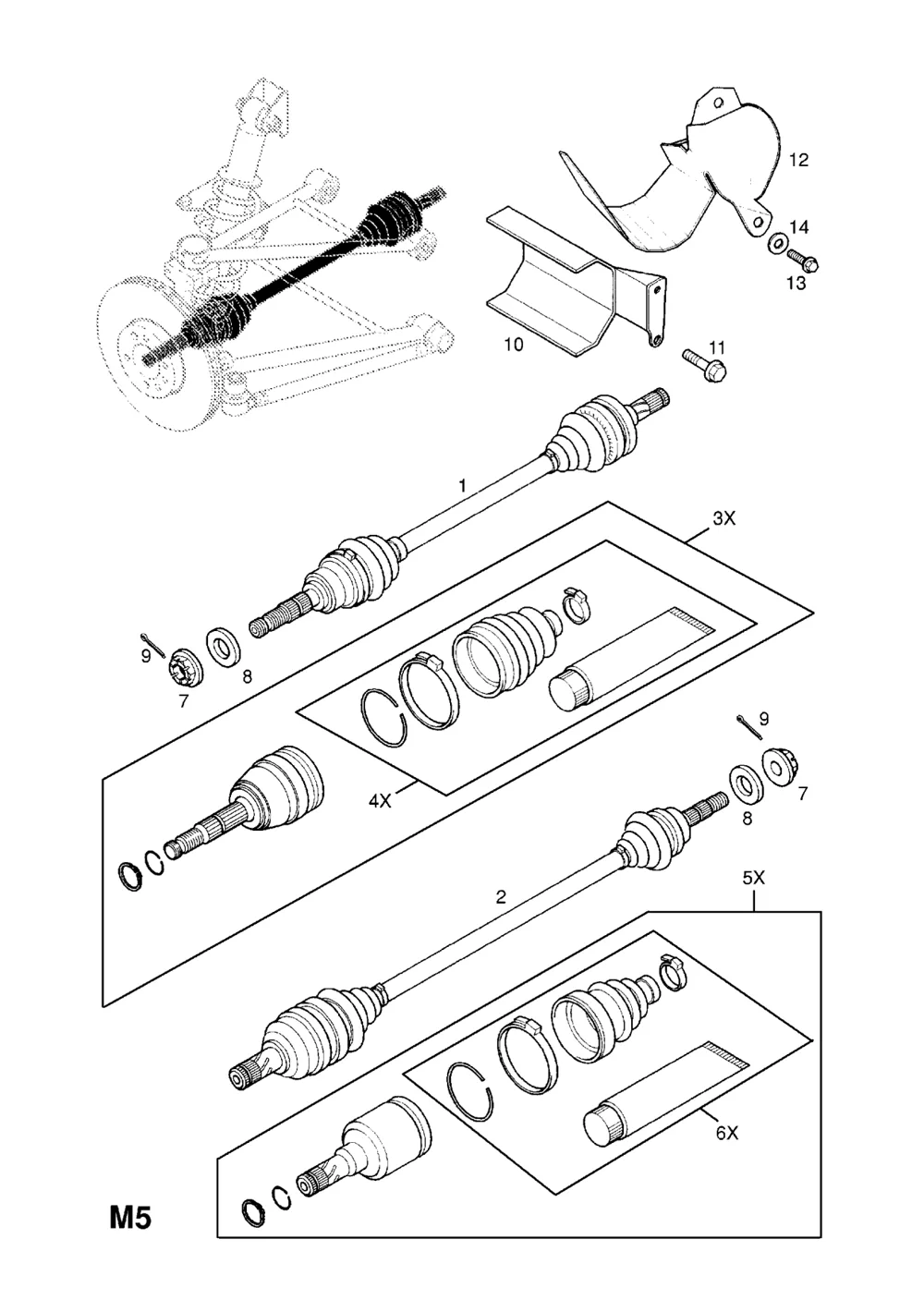
Swapping in a shaft from another car (2012)
This was one owner's report a day after fitting, for the short left-hand shaft only. Treat it as an idea to check, not a recommendation.
- An owner in 2012 fitted the short left shaft from an Astra H (Mk5) 1.7 CDTI, which also has the F23 gearbox, and said it went in smoothly with no leaks so far. He said complete shafts on eBay were very cheap, and that the new list price for a Speedster shaft was 750 euros.
- The locknut is different. You need the locknut from the Astra shaft. He thought it was 32 mm instead of 30 mm.
- He listed the compatible shafts as 1.3 CDTI (Z13DTH) and 1.7 CDTI (Z17DTH, Z17DTR). He didn't have a part number.
- Just the short one: he stressed that this works only for the short left shaft, not the long one.
- Joint size. Arno said a 32 mm nut suggests it may have different joints. If they are smaller, higher-power cars (supercharged or turbo) might struggle, since smaller joints have less area to handle power and heat. He pointed out that the S1 Elise has smaller Rover joints than the S2 and that Honda conversions on S1s overheat them unless uprated. The owner measured the biggest joint near the gearbox and said it was the same on both, and Arno then said it should probably be fine. He said a German friend told him that two turbo conversions and a few supercharged cars were running them. He said time would tell.
- Another owner pointed out that on S1 conversions the shafts are always swapped for expensive bespoke ones, and the boot splits there because of the shaft angle.
- Another owner asked whether a wiki of compatible parts from other cars should exist. We don't have one. If you know of other swaps, please tell us.
Help wanted
We don't have a current price for an OE driveshaft, a part number for the full shaft, a safe play figure at the diff, or any longer-term result for the Astra H short shaft. If you have bought or swapped a driveshaft recently, please tell us what it cost, where you bought it and how it has lasted.