
Never work under a car held only by a jack. Put axle stands under it, and chock the wheels that stay on the ground. These two threads are owners' advice and not a manual, so if in doubt check the factory service manual (see the manuals on the guides page).
Two forum threads, from 2004 and 2009, cover the same question, and this guide combines them. The short answer is: jack at the marked point on the sill, which lifts the whole side of the car. The other points are for lifts and for stands.
The main jacking point (the sill)
- It is on the centre of each sill, almost in line with the back of the door. Look under the car there for a sticker (described as blue).
- It lifts the whole side. Jacking at this one point raises the front and rear wheels on that side. Use it for a rear tyre. There is no need to remove the undertray for it.
- The sticker may be missing or covered in grime (one owner rubbed some off to read it). Look for the same position on the sill.
- One side at a time. One owner watched a tyre fitter with air cushion jacks lift one side, then go to lift the other, and says the car may tip if you lift both sides.
- One owner asked because there was already a hole in the sill on the driver side and he didn't want the tyre fitters to punch another. Make sure whoever lifts the car knows where the point is.
The jack and the wood
- A normal trolley jack works, with a block of wood on it. A square piece about the size of a CD case, 1 or 2 inches high, mainly stops the jack scratching the car and slipping, and also spreads the load.
- Other things people put between the jack and the sill: a thick non-slip rubber block (as used by a mobile tyre fitter) and a hockey puck on top of the jacking plate.
- A trolley jack moves as it rises: the jacking point moves inwards a few centimetres as the car rises, so if the jack is fixed in place the car could slide off. One owner who had slipped a jack meant only the jack that moved after the car was up, and the thread left the question there.
- Too big or too tall for the gap: one owner found that his work jack was too big, and touched the undertray before it reached the sill point. The replies: buy a low-profile jack (Costco often has them), drive onto wood or ramps first so you can get a normal jack in (one describes a ramp made from screwed-together chipboard), or use a rubber block or puck. The central point lifts the side easily, so find a way to use it.
Axle stands
- To take both wheels off one side: jack at the sill point, then support the car at the front and rear with axle stands (no objection in the thread). Put the stands in place on wood, lightly touching the front and rear points, with the jack still carrying the weight.
- A good rear stand position: where the rear subframe bolts onto the main chassis beam, which you can reach with a rear wheel on. It is similar to point C on the diagram below. One owner uses two wood blocks that fit into the angled recess and onto the stand.
The four-point diagram
The diagram, said to be from the factory TIS disc, shows more points. The lettered version is below, with the letters as the thread uses them. Owners say the diagram can look different from their car, and one believes it is missing another set of lifting points on the shear panel under the fuel tank.
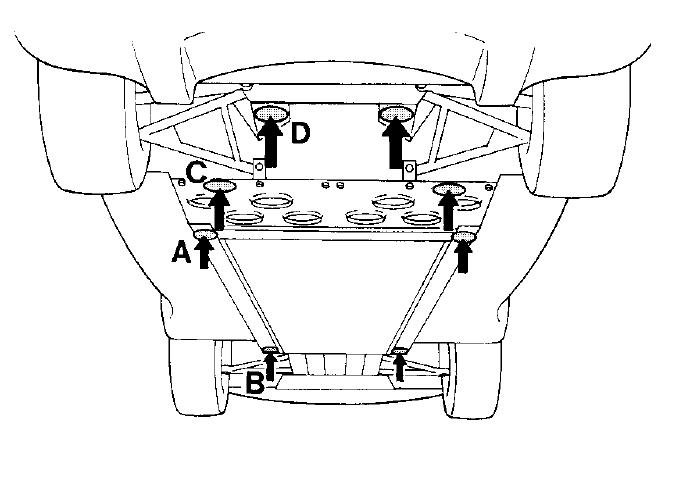
- A: the side point to use with a normal jack, and it lifts the whole side.
- B (front) and D (rear): for a four-point lift, or for lifting the front or the rear as a pair. You can twist the chassis by lifting at just one of these. The front points are always accessible.
- D, the rear points, are above the rear undertray. The undertray bolts to them, so the rear undertray or diffuser has to come off to reach them. You'll normally need the car up first.
- C is the rear subframe-to-chassis junction, used for axle stands (above).
Garages and lifts: a warning
Two-post lifts can tip the car backwards. Points A are very close to the centre of balance, and a car lifted on a two-post lift with its four swing arms at A (rear) and B (front) is in danger of overbalancing backwards. The same reportedly happened to an Elise. Use a four-post lift or a pit if possible. If you must use a two-post lift, strap the front suspension to the front leg until the undertray is off and the rear legs have been reset under the rear subframe (points D).
- The middle points (A) can be used on a two-post lift because they are just forward of where the undertray slides in, but they are right on the tipping balance point. The arms by the front wheels carry little weight because of the heavy engine, so a rear support under the gearbox is advisable when removing weight from the front, such as taking the front wheels off.
- At one dealer the car went on the lift and the undertray was removed while it was up. Another owner wonders whether it was lifted on its wheels first, with a lifting beam on the points afterwards.
- Before you take the car to a garage that doesn't know the VX, show them where the points are and how it should be lifted.
Not settled in the threads
- One owner says the only place to jack the front is with a long piece of wood between the "B" point and the other arrow, using a low trolley jack. Nobody confirmed this, and it conflicts with the advice to use the sill point, so don't rely on it without checking the manual.
- Whether the shear panel under the fuel tank has its own lifting points.
Help wanted
There is no photo of the sticker or the sill point in either thread, and no figure for the car's weight or the safe load of the points. A photo of the sill point from underneath, and a photo of a good axle stand position at C, would help a lot. The factory service manual (see the manuals on the guides page) is the place to confirm it.