
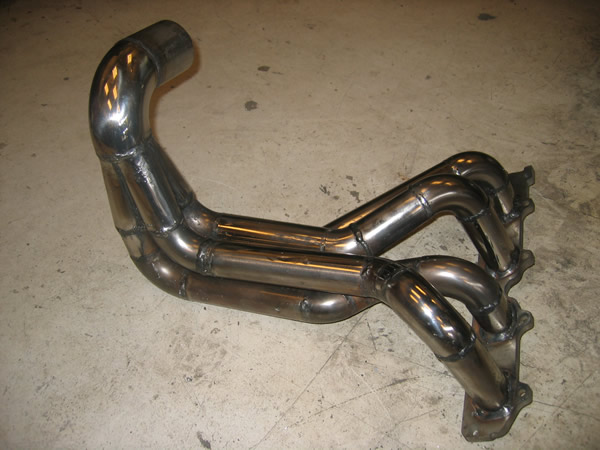
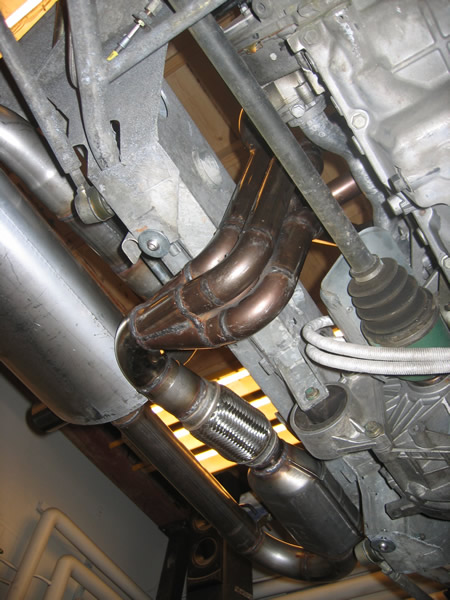
In 2006 one owner made his own 4-1 manifold and full 2.5 inch system for his NA, and posted the result. He had help with the welding. This page records what he did and what other owners said, as ideas, not a how-to. The 2006 thread's own photos are not recoverable. The two photos here were posted in a 2021 thread and show a long-primary 4-1 design of the same style.
What he built
- A 4-1 manifold with long primaries, built from 90 degree bends and straight pipes, carefully measured and cut, then point-welded into shape. A welder did the final welding. He says it wasn't that hard to put together, though it was his first exhaust.
- The rest of the system is 2.5 inch all the way, including a metallic hi-flow cat (a ready-made, all-metal unit) and standard parts.
- A fake lower tailpipe to keep the standard look. He later lost it, through some bad welding, and planned a letterbox tip like Regal's.
- He said the heat from the first run changed the shape of the tubes slightly, so some adjustment was needed, and he planned to add heat shields. He made one between the manifold and the boot.
Results he reported
- No engine warning light at first. It came on once just after fitting with a rear lambda sensor code; he reset it and it did not come back, through four track days. He had the same light once before with the standard system, so he suspected a tired rear sensor.
- The sound is racy but not loud. He felt the torque dip before 3,700 rpm was gone, though he said it might be placebo.
- He never put it on a dyno, so there are no gain figures.
The lambda sensor argument
He put the lambda sensor in the collector, on advice to place it as early as possible. Other owners disagreed:
- One owner thought it might not see all four cylinders' gas, and suggested moving it just before or after the flexi pipe.
- Another owner, who says he has analysed exhaust systems, agreed: put it outside the first bend or after the flexi, where the flow is more developed, not just inside the bend where gas recirculates. He also noted that flow through a cat is more uniform if the flow crosses the substrate at an angle, which the VX's space doesn't allow.
- The builder replied that his collector is open inside, so the sensor reads all four pipes. He considered the bend after the collector but didn't want to disturb flow through such a tight bend. The sliding joint beyond made the pipe after the bend unusable.
See Post-cat lambda sensor replacement and MAP and lambda sensor faults.
His view on wrapping
He chose not to wrap the system. His reasoning: on a naturally aspirated engine, an exhaust that loses heat has cooler, lower-volume gas, so there is lower back pressure; wrapping is only really good before the turbo on a turbo car, and is only worth doing on an NA if radiated heat is a problem. This is his opinion, and other owners take the opposite view. See Exhaust manifold heat wrap and shielding.
Design notes from the 2021 thread
- An owner planning a supercharged car wanted 44 to 45 mm primaries more than 600 mm long, with a 63 mm or 70 mm outlet. He argued the standard-pattern Tullet manifolds have short primaries, which he read should cost performance.
- Another owner's view: the gain from a long-primary design over a ready-made Tullet is "peanuts", and the real issue is longevity. See Supercharged exhaust advice.