
Don't keep driving on a leak that is losing oil. Check the dipstick often until you have found it. One owner (2010) said he had "failed to react fast enough" to a leak, and his engine later turned out to have heavily worn camshaft lobes and some rocker wear. He didn't say the leak caused it, so treat that as a warning from one car and not a finding.
On the NA, the owners in these threads found the cause in the oil filter housing seals far more often than anywhere else. Several said it before they had even looked. The list below goes through the other places that came up, and what made owners think they were not the filter housing. For the housing itself see Oil filter housing leak: seals, torque and the tool. For the filter and oil change see Oil and filter change. For oil coming from the gearbox see Gearbox oil leak: breather, overfill and seals.
Find it before you fix it
- Clean it first. several owners both said to wash the oil off with brake cleaner (or carb cleaner), from the top down, then run the engine and re-check. Oil creeps over surfaces, so it is very hard to pinpoint a leak that has spread. Cleaning also shows the height the leak starts at.
- Get it up and run it. Put the car on stands (or ramps with the rear up) and take the undertray off to look. One owner suggested running the engine a bit and checking for damp spots. A small leak may appear only a while after the engine is turned off (another owner found his that way).
- Talc. One owner suggested spraying a little talc around to find the wet bits. Another owner made the same suggestion (foot powder or talc, then a drive) for a gearbox leak.
- Expect a delay. After a fix, oil that has already escaped takes a while to work its way down to the undertray, so don't judge by the first few drops. He had the engine good and hot, and then gave the filter housing a second nip-up while warm.
- Was it new? One owner's first question: if the leak started after work, it is more likely something you touched. If it was there before, it could be many things.
- Is it engine oil? One owner asked this first of an owner whose engine was covered. Colour isn't a reliable guide. One owner was told gearbox fluid is red, but his was brown-orange, like engine oil, and another owner described a gearbox leak as yellowy. Another owner said gearbox oil has a horrible smell.
Where oil came from
| Where you see it | What owners found or suggested |
|---|---|
| NA, left side of the engine, below the filter housing, often over the sump, gearbox and undertray | The two metal seals around the oil cooler adaptor in the filter housing (NA). Several owners all reported it, usually after an oil change. One owner came back to say it was indeed the housing. Another owner said a bad seal floods out as soon as the engine is started. One owner tightened the cap hard and it stopped, but see the housing guide before copying that. |
| Around the NA oil cooler hoses and the cooler in front of the gearbox | One owner (2026): the NA has an oil/water heat exchanger in front of the gearbox with oil hoses to the filter housing ring and back to the block, and the rubber hose to the block may have gone brittle. Another owner mentioned the hoses and joints from the sandwich plate to the cooler. Nobody confirmed this as the cause in these threads. |
| Near the filter, a bolt facing the boot | One owner (2009) said a thermostat next to the filter has a bolt that faces the boot and can weep a surprising amount when warm, and that tightening it may be all it needs. He didn't say whether it was an NA or a Turbo. |
| Belt side of the engine, a line of oil from the crank pulley, or oil on the pulleys and belt | The front crankshaft seal (one owner said about £8 from AutoVaux; when his was not pressed in properly it threw oil off the pulley) or the timing chain cover gasket. In one thread the owner's offside spatter stopped completely after he had the timing chain done. One owner also thought oil running on to the alternator belt could make it slip and squeal. |
| High on the engine, or dripping down from the cam cover | The cam cover (rocker cover) gasket. One owner said it is the only place higher than the filter housing, isn't under high pressure and so would usually only weep. A lot of oil on the side of the engine is more likely to mean a bad gasket (another owner, on a Turbo). |
| Turbo: whiff of oil, puffs of smoke from the vents above the engine | The crank breather elbow. See below. |
| Turbo: oil around the turbo or the return pipe | One owner suggested checking for a cracked breather return pipe and the turbo oil return seal. The owner he was answering had an NA, so the second didn't apply. For a seep at the return pipe flange, see “Turbo: oil return pipe flange” below. |
| Rear of the engine, a slit at the bottom of the gearbox | The rear main seal. See below. It was suspected on a car whose real fault was the filter housing. |
| Oil on the inside of the near-side rear wheel, or running down the driveshaft | The gearbox breather or driveshaft seals. See the gearbox oil leak guide. One owner pointed out that on a newly bought car the previous owner had probably changed the oil recently, which points at the filter housing. |
| Next to the NA filter housing, a sensor | One owner wondered about the oil pressure sensor beside the housing, having read that it is mentioned for the Z22SE. In his case the housing turned out to be the leak. |
Turbo: breather elbow and cam cover
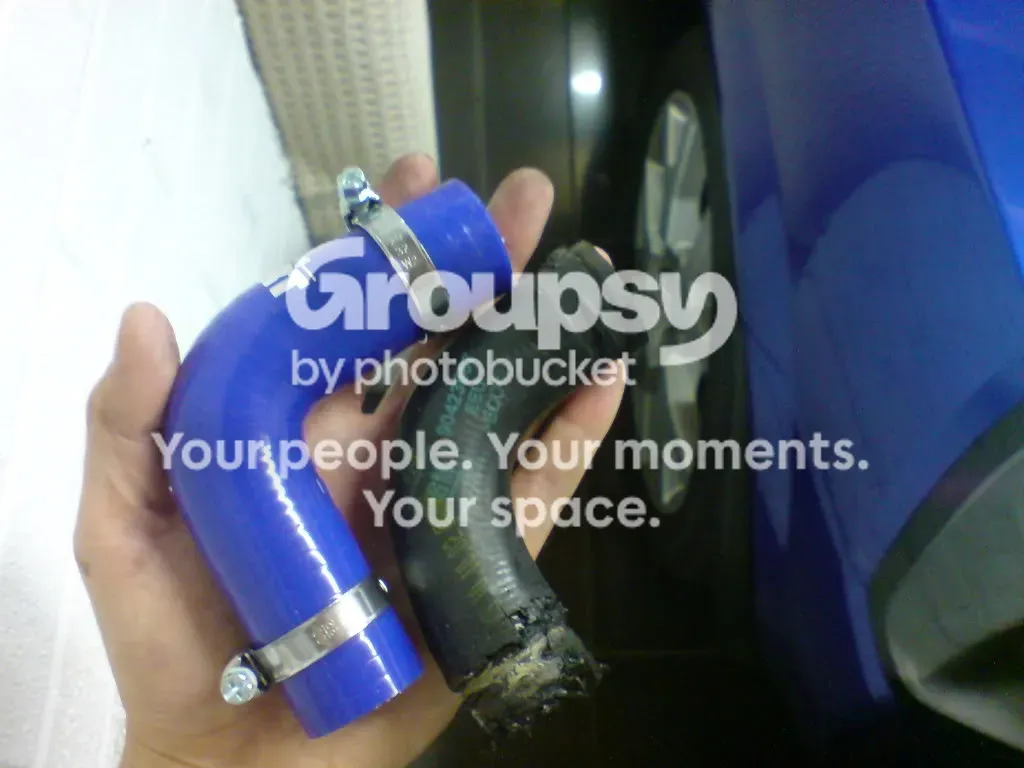
- In 2010 a Turbo owner noticed an oil whiff from the engine bay, then puffs of smoke from the vents above the engine on the motorway, and later smoke after he had shut the engine down. One owner identified the rubber 90 degree elbow that carries the crank breather to the top of the cam cover, which heat and oily vapour eat away. He gave the part as Vauxhall 90423667, 25 mm, about £8. Another owner thought it looked like a leaking cam cover gasket.
- One owner said it was unlikely to be the gasket because there would be more oil on the side of the engine, and sided with the elbow. Another owner said his Turbo had both the gasket and the pipe, both DIY jobs, and that the gasket's bolt O-rings are a separate part number from the gasket. The owner gave 90501944 as the cam cover gasket number, with a question mark, and it is not confirmed.
- One owner posted a photo of his own, showing a blue silicone elbow next to the old black one (below). The thread doesn't say where he got it. The original poster ordered both parts but the thread ends before he fitted them.
Turbo: oil return pipe flange (2015)
- One owner had a burning oil smell for 5 to 6 weeks and found nothing until he pushed an endoscope camera in under the turbo. The flexible return pipe from the turbo had oil over it and was seeping at its fixing flange, with both bolts tight. After cleaning it all off he idled the car for 15 minutes and saw no oil, and asked whether the turbo seals or the fixings only leak under load. Nobody answered, and he later said it was the return pipe. He didn't say how he confirmed it.
- One owner said to check it isn't the turbo's own oil seal before changing anything, and that as far as he remembered the original metal pipe and the later Z20LEH one don't differ. Another owner had bought the upgraded pipe from Courtenay Sport and said it can be fitted from under the car, but it is tight and you will hate the car afterwards.
- One owner suggested nipping up the two bolts first, which may be enough. Another owner doubted it from experience but said it was worth a try. A third owner tried and couldn't tighten them any more, and it still leaked. He bought the gasket from a dealer, plus a second one he described as a "19tdi" gasket (not explained). For the bolt head close to the engine, one owner thought a universal joint and extension bars would reach. Another owner said to take off the bottom return bolt, move the pipe to the side, remove the usual heat shield parts, and use the correct extension, and thought a 1/4 inch drive ratchet and socket helped (he wasn't sure of the size). It is a blind job.
- One owner had it done by 4 June, hated the access (and had skinned knuckles), and was waiting on oil for an oil change. No torque figure or gasket number is in the thread.
Rear main seal: check the cheap things first
- In 2013 an NA with 68,000 miles had a slight oil leak as an MOT advisory and was told it was the rear main oil seal. He asked whether that means the engine out, and planned to renew the clutch, slave cylinder and timing chain at the same time.
- Does the engine have to come out? One owner said a failed crank seal is usually a big job that needs the whole rotating assembly (crank, rods, pistons) out, though you could in theory do it from underneath with a good ramp. Another owner said the crank and rods don't come out, but the flywheel has to come off. A third owner said the Z22SE seal presses in with no problem (and with a wear ridge on the crank you can alter the seal's position slightly). One owner's concern was the Z20LET seal, which has a delicate spring that may not seat. Hammy added that all these seals have a spring and that a small screwdriver usually sorts it. So owners disagreed. We have no guide to doing it.
- Signs. One owner said a seal that has really given way sprays oil inside the gearbox housing, which may make the clutch slip and let oil drip from the 1 cm slit at the bottom of the gearbox. Hammy also said a wear ridge can appear on high-mileage cranks at the seal position.
- Check the filter seals first. One owner said it is usually the oil filter seals, because the oil runs to the bottom of the engine and looks like a rear main seal leak. Another owner added that the engine breathers are worth a check because it costs nothing, and a blockage can pressurise the crankcase and force oil past a seal. A third owner said a very slight weep can have no effect for years, so clean the area and see how much oil you get over a few weeks.
- Outcome. The garage found the oil filter housing seals leaking and fitted new ones (the owner said "bigger seals", which isn't explained), and the leak stopped, so there was no engine-out.
Case notes
- 2009, NA. Oil on the diffuser and undertray after a service, then no charge. The alternator and a cracked auxiliary belt turned out to be separate faults and were replaced (see Alternator testing and replacement). It took months: filter seals replaced (one pinched in refitting), the chain done, then a final pair of seals and a hot nip-up. The garage had used 0W-30 at the service where it started, where it had been 5W-30 before, and he wondered whether thinner oil leaks more. One owner replied that 0W-30 and 5W-30 have the same viscosity at 100 degrees C and differ only when cold. The thread didn't settle it.
- 2010, NA. Engine covered in oil on the left. The owner had the gearbox breather mod and an NA, so he ruled out the breather. It was the filter housing.
- 2026, NA. Oil on the engine mount and the engine and gearbox joint, a pool underneath, and damp near the starter. The owner thought the filter housing, replaced its gaskets, but found oil still coming from below the oil cooler ring into the back of the block. It took several attempts at the housing. See the housing guide.
Help wanted
We don't have a photo of each leak point, a torque for the cam cover bolts or the crank seal, a part number for the NA front crank seal or cam cover gasket that someone has checked, or a guide to a rear main seal job on either engine. If you have traced a leak, please tell us where it was, what you replaced and whether it stayed fixed, with photos if you can.