
The soft top's steel cables can snap. This 2011 write-up offers an alternative to replacing the cable: an archery bow string in place of the steel cable. It is a simple idea, and one that another owner liked well enough to plan to use, but you should know that it is a home-made fix from one owner, and the thread has only one report of it in use, after a year.
What you need to make
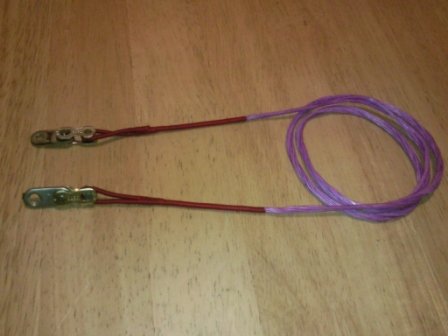
- The string. The author is an archer and made his own, from FastFlight, a waxed HMPE fibre that is very strong, very flexible and unaffected by moisture. His is about 950 mm long (he wasn't sure afterwards). Another owner found a supplier who would make up FastFlight Plus strings to 950 mm and was asked how many strands (14, 16 or 18) and what bow type. The author said 18 strands, which is a little stronger and creeps less, and to say it's for a recurve if asked. The thread doesn't explain what the bow type changes, though presumably it's the end loop size. If you can't find an off-the-shelf string the right length, an archery shop should be able to make one up.
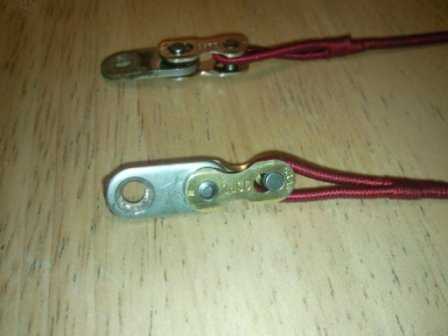
- Two chain split links, which join each string loop to the end plate.
- The two countersunk end plates from the original cable, which you re-use.
Steps
- Remove the cable and its fixings from the hood by taking out the countersunk Allen screws on each side.
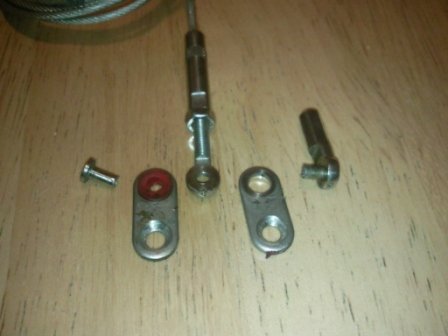
- Each end of the cable has a countersunk plate. Take the threaded adjuster and the fixed cable crimp off them. Each is held to its plate by a small pin that is peened over. Grind off the peening and drive the pin through with a punch. You should end up with two plates, and you can throw away the rest.
- Refit the countersunk plates on both sides of the hood.
- Thread the string through the hood. Thread a bike brake cable through first, tape the string to one end and pull it back through.
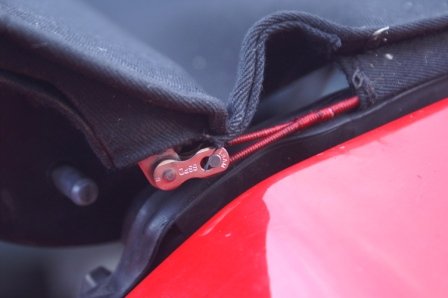
- Working on one side, push one half of a chain link through the plate, loop the string over the other half and connect them. Do the same on the other side and test-fit the hood.
Adjusting the tension
There is no adjuster. You release the string on one side, twist it a few times to shorten it, and reconnect. It is a little harder than turning an adjuster, but takes a minute or so.
How it got on
- Moisture and mould: the fibre is unaffected by moisture and is waxed, and the author couldn't see it promoting mould any more than the damp hood itself would.
- After a year (2012): it was holding up fine, with outdoor storage all winter. The only problem was surface rust on the chain links, and stainless versions are available.
- Another owner had a cable let go in 2012. He ordered a couple of replacement cables from a supplier instead and was pleased with them, but said he would use the string method next time. So nobody else in the thread reports a result.
The other option: aftermarket replacement cables
One owner says the replacement cables from one supplier are a different design to the standard ones. They are basically the same layout as the string version, but in stainless steel cable and with an adjuster, which removes the single stress point of the original. The thread doesn't say whether they are still sold.