
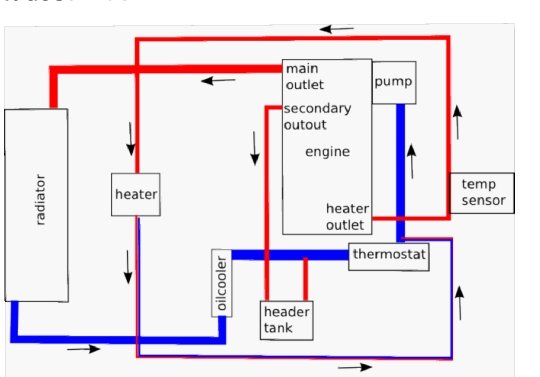
This is one owner's flush procedure for a VX220 Turbo used on track. He had black residue appearing in his header tank, was "pretty confident" it wasn't the head gasket, and wanted a thorough clean before the season. The manual's method is to disconnect the return hose by the oil cooler and the radiator hose. He didn't want to take the front undertray off if he could avoid it, so he came up with this instead: remove the thermostat, disconnect the outlet of the oil cooler, and blank off the return pipe that leads to the thermostat. Then he pushed water through from the header tank outlet, through the engine, radiator and oil cooler, and out to the drain.
Preparation
- Get the car up to temperature first (about 87 degrees).
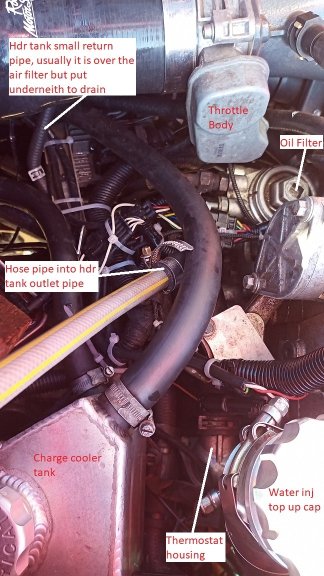
- Remove the header tank and give it a thorough clean. Take off the black bracket that the header tank and the charge cooler tank attach to, to give yourself more room.
- Remove two bolts from the rocker cover so you can pull the water injection top-up pipe out of the way.
- Put a container under the gearbox to catch the worst of the coolant.
- Remove the two 10 mm bolts holding the thermostat housing, and take out the thermostat and its rubber O ring. Bolt the housing back on (without the gasket).
- Put the car on four axle stands.
First flush
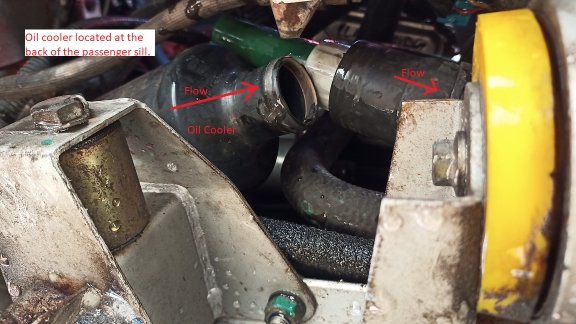
- Disconnect the outlet of the oil cooler. It is under the car, just where it leaves the back of the passenger sill. Collect the water that comes out.
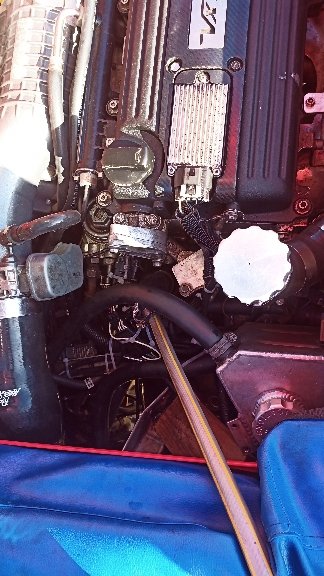
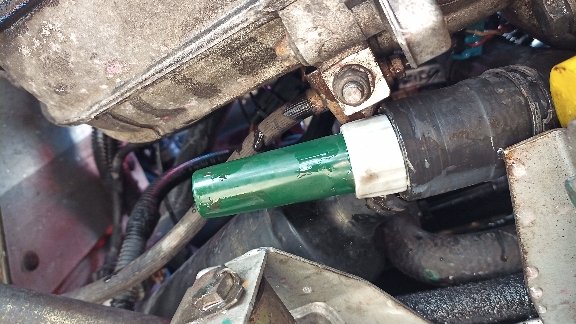
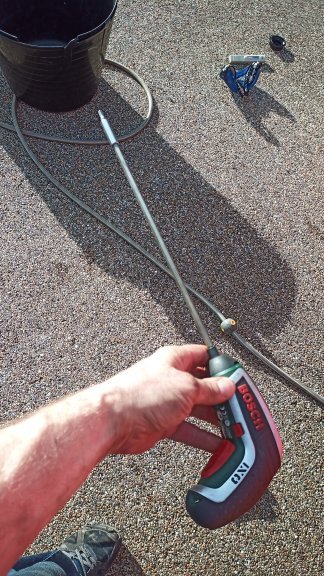
- Push a hose pipe as far as it will go (about 4 inches) into the hose that is normally on the header tank outlet, which is the thermostat inlet, and hold it with a Jubilee clip.
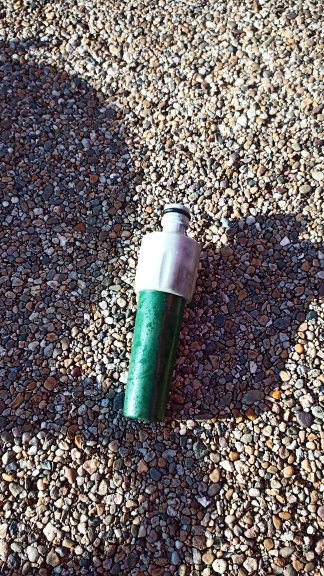
- Blank off the hose from the oil cooler outlet (the other thermostat inlet, on the engine side of the cooler). The author used a cheap hose attachment of the right diameter, 32 to 35 mm, which just pushed in and didn't need clipping.
- Blank off the small pipe that returns to the top of the header tank. A large bolt will do.
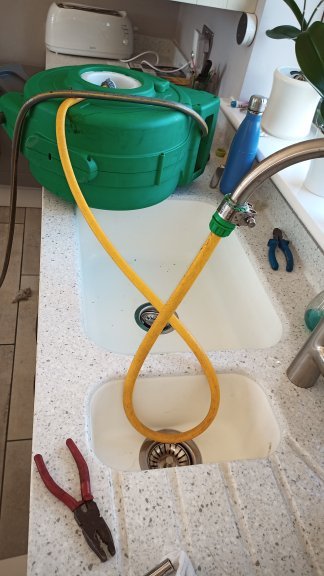
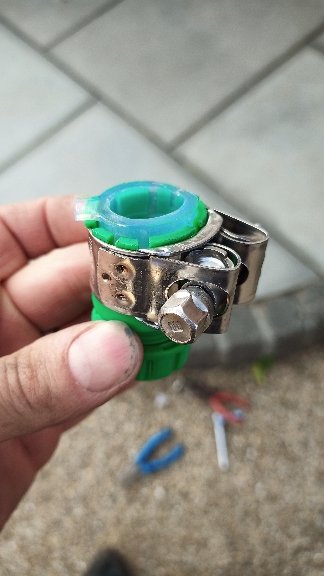
- Run hot water from the kitchen tap through the system to help dislodge more debris. Collect the worst of the water for proper disposal and run the rest to a drain. You need a Mikalor clamp on the tap attachment to keep the hose on, and no kinks in the hose.
- Take the small bolt out of the return to the header tank and flush through that too.
- Reattach the oil cooler and fill the system with hot water until it flows well out of the small return pipe to the header tank.
Chemical clean and second flush
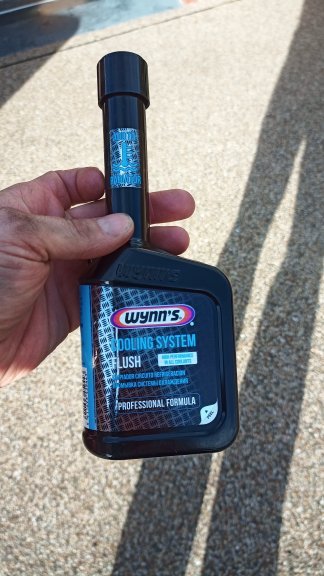
- Disconnect the hose pipe, reattach the header tank and add the cooling system flush product, a dishwasher tablet and a bit more hot water.
- Run the car with the header tank cap off, so the air can purge, and with the heater on maximum. With the thermostat out it takes a while to get to temperature, but the hot water helps. When it reaches 87 degrees, stop the engine.
- Disconnect the oil cooler, header tank and so on again, as in the first flush, and flush it through really thoroughly.
Refilling
- Reconnect the oil cooler and fill the system until it overflows from the small return pipe.
- Disconnect the hose pipe. Push the screwdriver end into that pipe, and put the bolt back in the small return pipe to the header tank. This temporarily seals the system so that you don't lose water when you take the thermostat cover off.
- Take off the thermostat cover and refit the thermostat. Don't forget the flat O ring.
- Reconnect everything.
- Put red antifreeze in the header tank up to halfway. The author got about 2.7 litres in, which he says is just under 25%.
- Run the car up to 90 degrees with the header tank cap off and the heater on.
The author finished by saying it felt like a thorough job, and that he would see whether the black residue returned after heavy track use. He didn't report back in the thread.